

Headless Drupal: The Secret of Flexibility and Speed in Modern Web Architecture

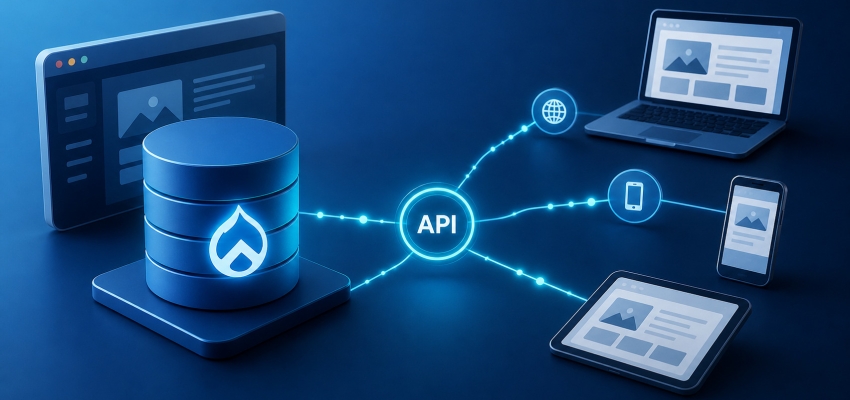
Headless Drupal is a modern web architecture approach that separates content management from the frontend layer. In traditional Drupal architecture, content and presentation are managed within the same system, whereas in Headless Drupal, content is delivered to different platforms through APIs.
Thanks to this structure, it becomes possible to develop more flexible, faster, and scalable solutions for websites, mobile applications, and other digital channels. It is especially preferred in projects where performance and user experience are a top priority.
In this article, we will explore what Headless Drupal is, how it works, and why it plays an important role in modern web projects.
What is Headless Drupal and How Does It Differ from Traditional Drupal Architecture?
Headless Drupal is a modern architecture approach in which the content management system (CMS) operates only on the backend, while the frontend is developed entirely with independent technologies. In traditional Drupal architecture, content and design are managed together within the same system, whereas in Headless Drupal, content is distributed to different platforms via APIs.
This fundamental difference creates a clear distinction between Headless Drupal and traditional Drupal in terms of flexibility, performance, and development approach. The clearest answer to what Headless Drupal is lies in its ability to deliver content not limited to a single channel, but to websites, mobile applications, and other digital experiences.
Thanks to this structure, developers can use modern frontend technologies such as React, Vue, or similar frameworks, while Drupal is responsible solely for content management.
How Does Headless Drupal Work and Why Is It Preferred in Projects?
Headless Drupal works by separating content creation from the presentation layer and managing this structure through APIs. While Drupal functions as a content management system in the backend, different technologies (such as React, Vue, or Angular) are used on the frontend to deliver the user experience. This architecture provides significant flexibility, especially in multi-channel digital projects.
How Headless Drupal works and why it is preferred:
- API-based structure: Content is delivered to different platforms via APIs such as REST or GraphQL.
- Frontend independence: Design and user interface are developed independently from Drupal.
- Multi-channel support: Websites, mobile applications, and other digital platforms can use the same content source.
- Higher performance: Page load times are reduced thanks to a lightweight frontend structure.
- Developer flexibility: It allows working with different modern technologies.
For these reasons, Headless Drupal is preferred especially in projects that require scalability and performance. Content is managed from a single central source and can be distributed quickly and efficiently across different platforms.
Advantages and Disadvantages of Headless Drupal?
Headless Drupal offers many advantages in terms of flexibility and performance in modern web projects, while also introducing additional technical requirements in some cases. Therefore, it is important to evaluate both its strengths and limitations together.
The table below summarizes the main advantages and disadvantages of Headless Drupal:
| Advantages | Disadvantages |
|---|---|
| High performance and fast page load times | More complex development process |
| Flexibility thanks to frontend and backend separation | Requires technical knowledge and expertise |
| Multi-platform (web, mobile, app) support | Initial setup cost may be higher |
| Integration with modern frontend technologies | Content management and frontend may require separate teams |
| Scalable architecture | Limited availability of ready-made theme structures |
Where is Headless Drupal Used? Real Project Examples
Headless Drupal is especially preferred in modern digital projects where content needs to be used across multiple platforms. The ability to distribute content via APIs to different channels makes it suitable for a wide range of use cases, from websites to mobile applications.
Main project types where Headless Drupal is used:
- Corporate websites: Enables multiple teams to produce content while managing it from a single central system.
- E-commerce platforms: Used to deliver fast interfaces and personalized shopping experiences.
- Mobile applications: Allows the same content source to be used in both iOS and Android apps.
- Digital products and SaaS platforms: Provides easy integration with different services thanks to its flexible API structure.
- Omnichannel content platforms: Content can be distributed to web, mobile, kiosks, and other digital screens.
For example, large-scale media websites use Headless Drupal architecture to deliver news content simultaneously on both their website and mobile applications. Similarly, global brands manage multilingual content for different countries from a single central system, ensuring a faster and more consistent publishing process.
These use cases clearly show why Headless Drupal is preferred in projects that require scalability, speed, and multi-channel content management.
Performance and Architectural Differences Between Headless Drupal and Traditional Drupal
The main difference between Headless Drupal and traditional Drupal lies in how the content management and presentation layers are structured. This difference directly affects performance, flexibility, and the development process. In traditional Drupal, the frontend and backend operate within the same system, while in Headless Drupal these two layers are completely separated.
Key differences between Headless Drupal and traditional Drupal:
- Architectural structure: Traditional Drupal has a monolithic structure, while Headless Drupal uses a decoupled architecture.
- Performance: Headless Drupal generally offers faster page load times due to its lightweight frontend structure.
- Flexibility: The Headless approach allows the use of different frontend technologies, whereas traditional Drupal is more limited in this regard.
- Content delivery: Headless Drupal distributes content via APIs to multiple platforms, while traditional Drupal focuses on a single web interface.
- Development process: In Headless architecture, frontend and backend teams can work in parallel, which increases development speed.
Overall, Headless Drupal provides advantages in performance and scalability for modern, multi-channel projects, while traditional Drupal stands out as a faster-to-deploy solution for simpler, single-platform projects.